Find a Branch

Commercial Credit at Exchange Bank: Term Loans, Lines and Asset-Backed Facilities

Exchange Bank writes conventional commercial credit for Sonoma County operators across six main product shapes — business term loans from $10,000 to $1.5 million, seasonal and permanent business lines of credit, equipment finance, inventory financing, receivables (A/R) financing, and SBA 7(a)/504 packaging for deals that exceed the in-house limit. Underwriting sits in Santa Rosa, so loan officers know the industry context — vineyard cash cycles, hospitality seasonality, construction retainage, professional-services receivables.

Compliance follows Reg B (equal credit opportunity), Reg Z (truth-in-lending where applicable), and the Federal Reserve's commercial lending supervisory guidance. Files are reviewed by the in-house credit committee for deals above $250,000.

Apply With a Business Banker Explore SBA 7(a) & 504
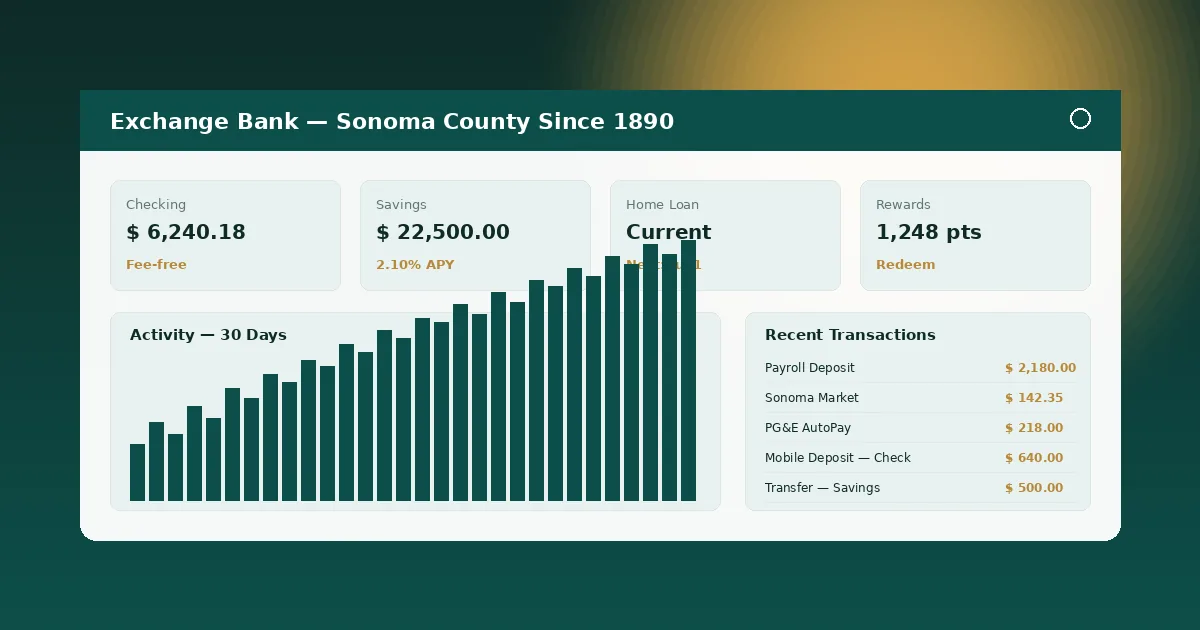
Exchange Bank commercial credit dashboard showing term loans, revolving lines of credit, equipment finance and inventory borrowing base for a Sonoma County operator

Business Lending Reference: Six Commercial Credit Products

Match the facility shape to the capital use. Working capital gets a revolving line, equipment gets an amortising loan, seasonal inventory gets a seasonal line — aligning structure to cash flow prevents the most common credit failures.

Business Term Loan ($10K-$1.5M)

The business term loan at Exchange Bank is the workhorse for acquisitions, owner buy-outs, debt consolidation, leasehold improvements and long-cycle capital expenditures. Terms run 1 to 10 years depending on purpose, with fixed or floating rate options. A Santa Rosa professional-services firm acquiring a competitor book of business typically structures as a 7-year term loan with a 5-year balloon, amortising across the full 7 years. A Petaluma manufacturer consolidating three legacy equipment loans into one facility uses a 5-year fully-amortising structure. Above $1.5 million, the deal is packaged as SBA 7(a) to extend amortisation and stretch capital.

Business Line of Credit ($25K-$1M)

A business line of credit is a revolving facility sized to cover working-capital swings — seasonal inventory buys, receivables timing gaps, bridge capital around a known event. Seasonal lines pay down each year; permanent lines are reviewed annually and renewed. Pricing floats against the Wall Street Journal prime rate or a SOFR spread. The most common use in Wine Country is a seasonal line for a tasting room or boutique retailer to fund spring inventory, then sweep down through summer tourism. A clean-up requirement (30-60 days at zero balance annually) is standard on seasonal lines to distinguish them from permanent working-capital credit.

Equipment Finance

Equipment finance from Exchange Bank is secured by the equipment itself with a UCC-1 perfected lien. Advance rate runs 80-100% on new equipment with established secondary markets — commercial kitchen equipment, fleet vehicles, medical imaging, printing, winery crush and bottling equipment. Terms match useful life, typically 3-7 years. The credit decision focuses on the equipment's resale characteristics and the borrower's operating cash flow rather than real-estate collateral. Closing runs 10-14 business days from complete application. Equipment finance frees the operating line and real estate for other uses.

Inventory Financing

Inventory financing is a revolving line secured by a pledged inventory borrowing base. Typical advance rate is 50-65% of eligible inventory at cost, with ineligibility carve-outs for slow-moving, obsolete, consignment and in-transit goods. The borrower submits a monthly borrowing-base certificate reconciling physical inventory to the advance. A Healdsburg specialty-foods distributor uses inventory financing to pay import suppliers at the port, carrying the inventory through the bank's advance until product ships to downstream retailers and converts to receivables. An annual field exam validates the borrowing-base methodology.

Receivables (A/R) Financing

Receivables financing is a secured revolving line advanced against eligible accounts receivable — typically 75-85% on A/R under 90 days, with ineligibility carve-outs for concentration, cross-aging and foreign receivables. Unlike factoring, the borrower retains collection responsibility and customer relationships. A B2B Petaluma service company with $3M in monthly billings to mid-sized corporate customers uses a receivables line to accelerate cash while waiting on standard 45-60 day commercial payment terms. Monthly A/R aging reports govern the advance. The facility grows with the company's sales volume without requiring frequent credit re-underwrites.

SBA 7(a) & 504 Packaging

Deals above $1.5 million or with structures that benefit from SBA guaranty support are packaged in-house by the SBA team at Exchange Bank. As a Preferred SBA Lender, the bank makes credit decisions in-house rather than routing each file to the SBA, which typically compresses decision time from 10-12 weeks to 6-8. SBA 7(a) scales to $5 million with 10-25 year amortisation. SBA 504 handles owner-occupied real estate and large equipment up to $5 million with a CDC second mortgage. See the SBA Preferred Lending page for the full programme map.

Commercial Credit Facility Comparison

Seven facility shapes, their amount ranges, term lengths, pricing styles and the customer profile they fit best.

FacilityAmountTermRate TypeBest For
Business Term Loan (small)$10K-$250K1-5 yearsFixedLeasehold improvements, small-dollar equipment, debt consolidation
Business Term Loan (mid)$250K-$1.5M3-10 yearsFixed or floatingAcquisitions, owner buy-outs, capex, goodwill
Business Line of Credit (seasonal)$25K-$500K12-month renewalFloating (prime + spread)Seasonal inventory, tasting-room spring buys
Business Line of Credit (permanent)$100K-$1MAnnual reviewFloating (prime or SOFR)Working-capital buffer, receivables timing
Equipment Finance$25K-$1.5M3-7 yearsFixedCrush pads, medical imaging, fleet, POS installs
Inventory Financing$100K-$1MRevolving, annualFloatingDistributors, importers, seasonal wholesale
Receivables Financing$100K-$1MRevolving, annualFloatingB2B services, growing wholesale, professional firms

Credit Parameters At A Glance

Typical parameters Wine Country operators reference when sizing a request.

$1.5MIn-House Term Loan Ceiling
10yrMax Conventional Term
85%A/R Financing Advance Rate
$5MSBA 7(a) Package Ceiling

Underwriting, Documentation & Timing

What an application looks like and how fast a clean file moves.

Documentation Standard Package

A complete commercial credit application at Exchange Bank includes three years of business tax returns, year-to-date financials (income statement and balance sheet), a current accounts-receivable aging and accounts-payable aging, personal financial statements for all 20%+ owners, three years of personal tax returns for those owners, corporate documents (articles, operating agreement or bylaws, entity good-standing) and a signed business loan application. Real-estate-collateralised deals add appraisal, environmental Phase I (above $500K collateral) and title commitment. Receivables and inventory lines add a borrowing-base certificate template.

Decision timing on a complete file runs 5-10 business days for deals up to $250K, 10-20 business days for deals $250K to $1M, and 20-30 business days for larger and collateralised credits. Incomplete files extend the cycle.
Commercial credit documentation checklist with tax returns, financials, A/R aging, UCC-1 and credit committee review sequence
Credit committee review flow showing analyst recommendation, committee vote, approval letter and closing document generation

Credit Committee & Decisioning

Deals up to $250,000 are approved by the commercial lender and a second signing officer under delegated authority. Deals above $250,000 go to the in-house credit committee, which meets weekly and includes the chief credit officer, senior lenders and the SBA team lead. The committee reviews the credit memo, financial spread, collateral coverage, industry context and exceptions. Local committee membership — rather than a remote centralised approval centre — is the operating difference between a community bank and a larger institution. Committee members know the Sonoma County market context.

Per Federal Reserve community-bank lending studies, the lender-committee relationship is a measurable factor in small-business loan approval rates.

Collateral & Personal Guaranty Expectations

Conventional commercial credit at Exchange Bank typically requires a personal guaranty from each 20%+ owner, consistent with SBA and FDIC safety-and-soundness guidance. Secured loans carry a UCC-1 filed against the specific collateral (equipment, inventory, receivables) or a blanket UCC for general working capital lines. Real-estate-secured loans add a deed of trust, title insurance and hazard/flood insurance. Cross-collateralisation across the borrower's facility stack is standard to ensure appropriate coverage ratios across the relationship. Release of specific collateral requires a credit-department review and is routine when loan balances decline against collateral values.

Reg B (equal credit opportunity) governs spousal-guaranty practice, and files are documented to show the guaranty is not required solely on account of marital status.

UCC-1 financing statement, deed of trust and blanket lien documentation with collateral coverage ratio displayed

Three Borrower Profiles

Different Sonoma County operators, different facility shapes.

Vineyard Crush Pad Equipment

Sonoma Valley vineyard replacing crush-pad equipment uses a $380K equipment finance facility. 7-year term, fixed rate, UCC on the crush equipment. Closing in 12 business days after complete file. Operating line stays intact for working-capital needs.

Restaurant Group Working Capital

Two-location Healdsburg restaurant group opens a $250K permanent business line of credit. Annual review, floating pricing, monthly financial reporting. Used for timing receivables from catering events and bridging pre-tourism-season inventory and payroll.

Distributor Borrowing Base

Petaluma specialty-foods distributor with $4M in annual revenue uses a $600K inventory line plus $400K receivables line. Combined $1M working-capital facility grows with the borrowing base. Monthly certificates, annual field exam, blanket UCC.

Start a Commercial Credit Conversation

A commercial lender at Exchange Bank can review your use-of-funds, collateral profile and cash-flow pattern in a 45-minute intake meeting. Reach the commercial team at 707-524-3000 extension 1100, or visit any Sonoma County branch.

Connect With a Lender

People Also Ask

What is the size range for a business term loan?
$10,000 to $1.5 million in-house. Above $1.5M packaged as SBA 7(a) to $5M. Terms 1-10 years.
How does a seasonal business line of credit work?
Revolving facility $25K-$1M, aligned to operating cycle, annual clean-up requirement, floating rate.
Is equipment finance secured by the equipment?
Yes, UCC-1 filed against the equipment. 80-100% advance rate on new equipment. 3-7 year term.
What is inventory financing used for?
Revolving line secured by inventory borrowing base, typically 50-65% of eligible inventory at cost.
How does receivables financing differ from factoring?
Receivables financing is a secured revolving line against A/R, borrower retains collection. Factoring is an outright sale.

Related Small Business Services

SBA Preferred Lending

SBA 7(a), 504, Express and CAPLines packaging.

Commercial Real Estate

Owner-occupied and investment CRE to $10M.

Small Business Checking

Operating accounts pairing with credit.

Treasury Services

ACH, wires, lockbox for funded relationships.

Personal Credit

Personal credit for owner-operators.

Digital Banking

Online loan-balance view and statement archive.

California Community Banking — Topic Cluster